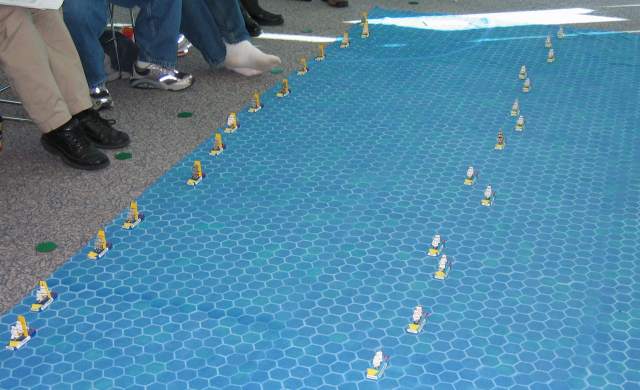
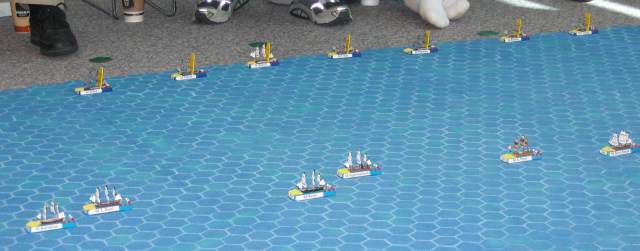
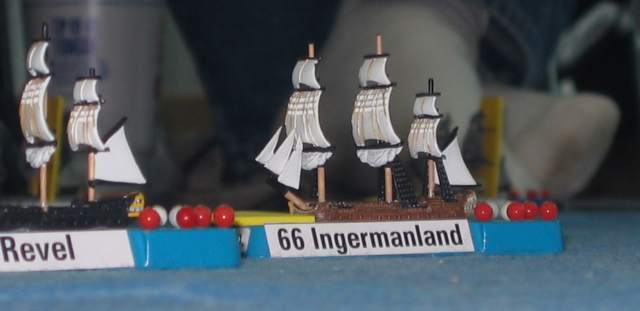
This game was a what-if action fought between the Swedes and Russians in the mid-18th century. Mark Campbell ran the game using his Close Action rules.
I was running the 66-gun Ingermanland which, despite the Swedish-sounding name, was a Russian ship. Though nothing too impressive by Trafalgar standards, the Russian 66ers are amongst the bigger ships in this Baltic battle. For this scenario, only the Russian Svyatoi Aleksandr (70) and Swedish Ulrika Eleanora (74) and Enighet (70) have a heavier broadside. (I note that the Swedish Gotha is rated as 72, but has a lower LG rating than Ingermanland for some reason.)
So if the following commentary tends to be Ingermanland-centric, that's why. Apologies to those other participants whose stories might be more interesting - though I had a good time, I voluntarily moved just nineteen hexes during the entire 20-turn battle. I think some of the faster Swedish ships did that in just three or four turns.
Crew quality is D throughout. Russian morale is mostly 3 with some 4s, Swedish mostly 4 with some 3s.
(Mouse over a thumbnail to see title; click for enlargement.)
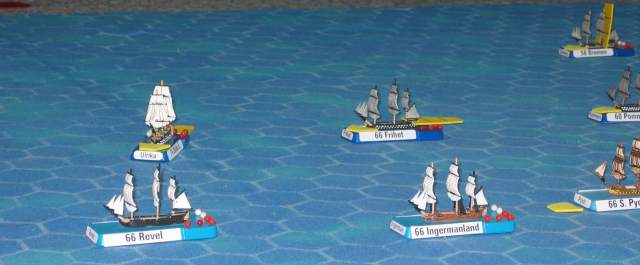
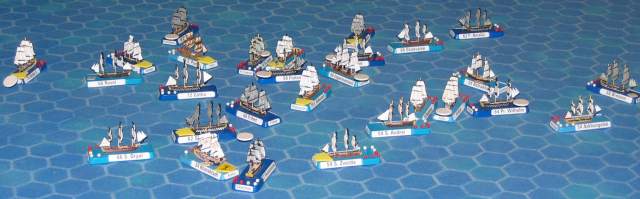
We began as usual in two parallel lines, the Swedes (in dark bases) to the left and the Russians (in light bases) to the right. The wind is coming from the left, so we're all sailing close hauled, with the Swedes at Plain Sail (with the yellow vertical sail markers) and the Russians at Medium Sail (yellow markers on the bow).
But the initial scatter did us no favors. Revel and Ingermanland, the fifth and sixth ships in the Russian line, have huge gaps in front of and behind them. Fortunately the Swedes were far enough away that we had time to redress the line.
The Russian plan was to have the van and rear squadrons fall to leeward and overlap the ends of the heavy
66s in the center. The resulting formation should have had the center covering the gap between the other two
squadrons, somewhat like the layout of bricks in a wall. Since the Swedes had the wind gauge, we knew they'd
come to us; when they tried to break our center line, the backup squadrons would then have raking opportunities.
We had explicit orders for the first three turns to fall back a bit. Our line looks in better shape already, though
Revel and Ingermanland still look lonely.
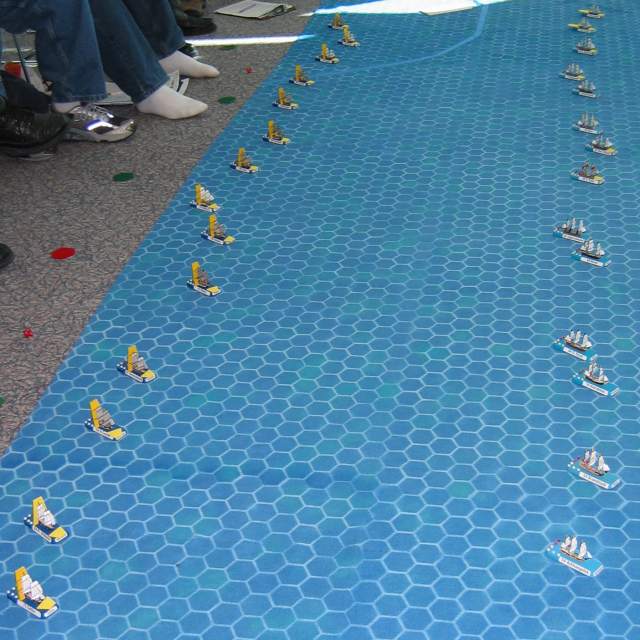
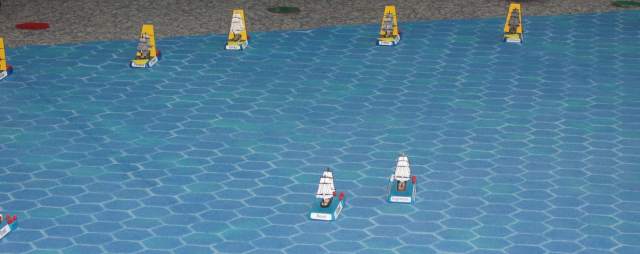
By the end of turn three, the gaps in the Russian center had largely been addressed. The Swedes were obviously looking
to outrun our van, and were succeeding in doing so. Some ships may have fired this turn, but Ingermanland's targets
were still a hex or two too far away to make shooting worthwhile.
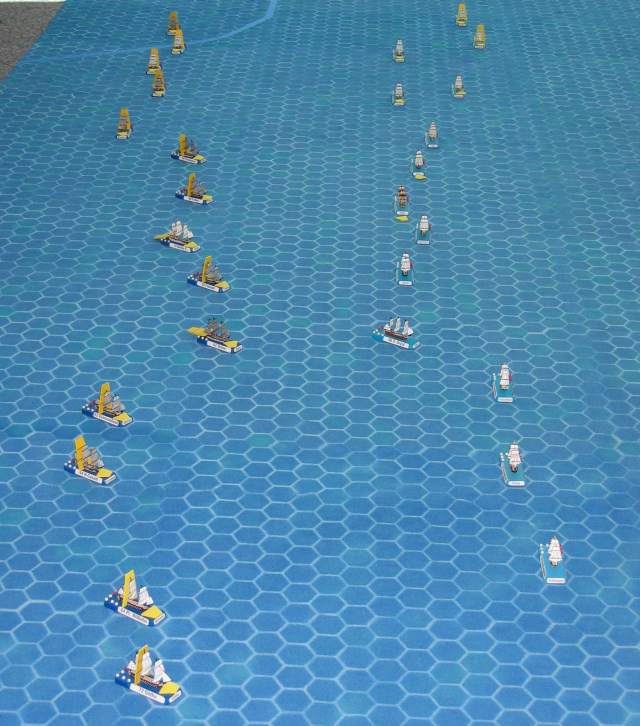
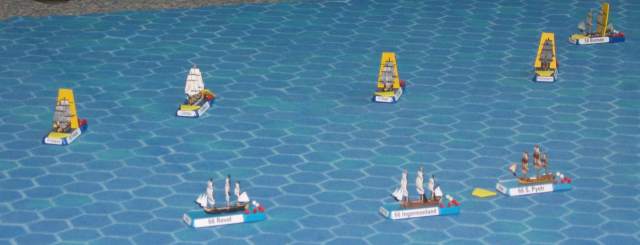
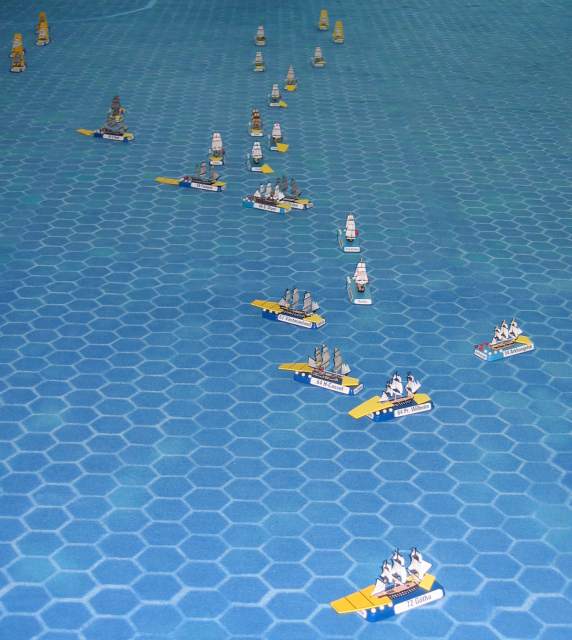
Now the action really began. Skåne -- the Swedish ship facing the upper right -- moved to cut our line just ahead of Revel. You can see our lead ships beginning to turn to avoid being raked. At the time I remember hoping that both Revel and Ingermanland between them would be able to put some serious damage on Ulrika, but we got no lucky criticals...yet.
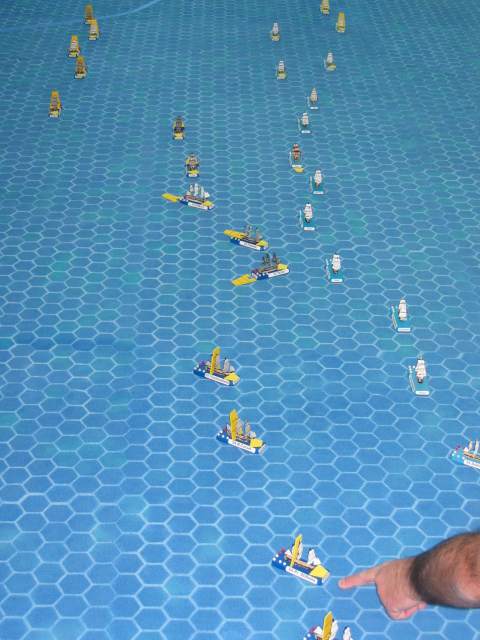
Things continue to heat up as Skåne zips through the Russian line. The Swedes have an excellent position now. Though Gotha, their lead ship, appears to have swung too far out, Kronshadt (2nd Russian ship) and Revel (on the other side of the Swedish cut) are facing three enemy ships each.
Our center, having mostly dropped to Fighting Sail in the first turn or so, got an order to raise sails, so we did so. At this point, a quarter of the way into the game, Ingermanland has moved about half her total voluntary movement.
I initially plotted fire against Frihet to take advantage of the rake, but I got a gentle reminder that a half broadside against the closer (and already damaged) Ulrika might be a better move, so I took that instead.
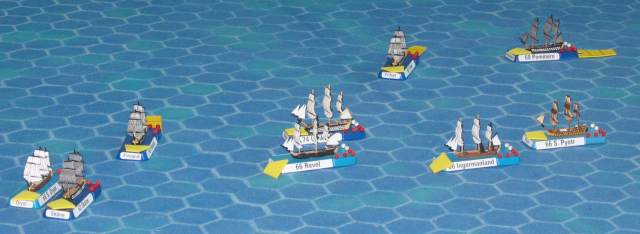
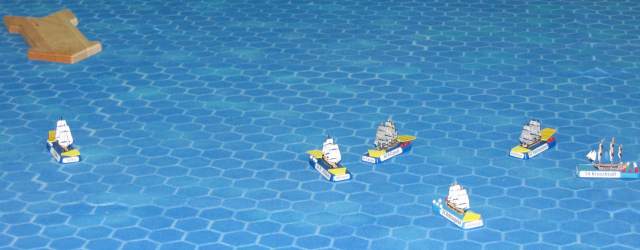
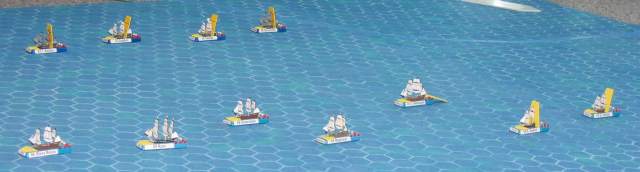
I made another dummy mistake as I failed to note that the "WEAR PORT BROAD-REACHING" (I think I got that right) signal wasn't addressed to all ships, it was only addressed to the van. But my mistake was forgiven, so my P1P plot got changed to 3 and I maintained my place in the line. And here I was so proud of myself for figuring out what the signal meant!
Gunfire this turn began to see some real results. Despite my switching fire to Frihet, Ulrika lost a rigging section, and Skåne and Revel each lost a hull section.
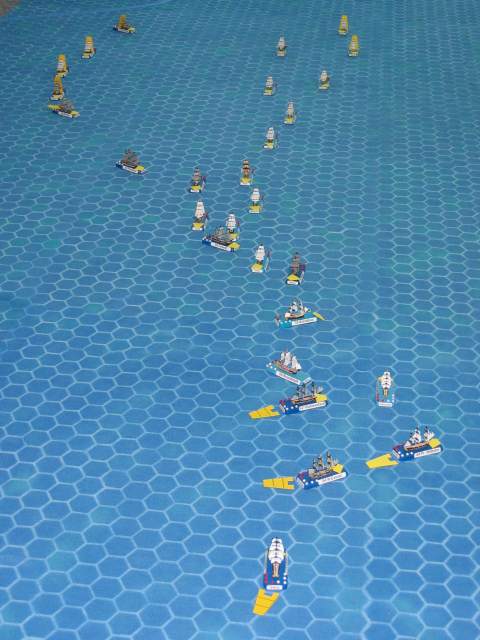
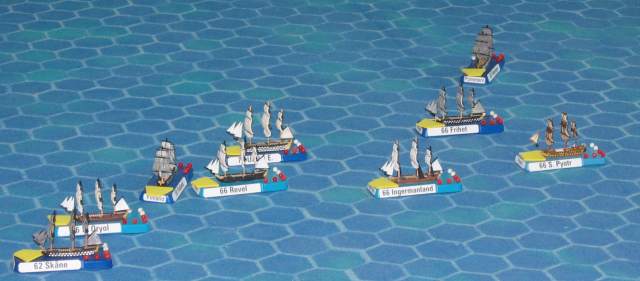
I don't have many notes or recollections of turn 7. Skåne is in trouble, but the Swedes have a slight numerical advantage of engaged ships. With the rear squadrons moving up and the van squadrons heading towards the rear, a general compacting of the action began around now. Though things are still open at this point, the position later will become quite congested indeed.
Ingermanland took her first damage (two rigging, one hull) this turn. Oh well, I couldn't stay pristine forever.
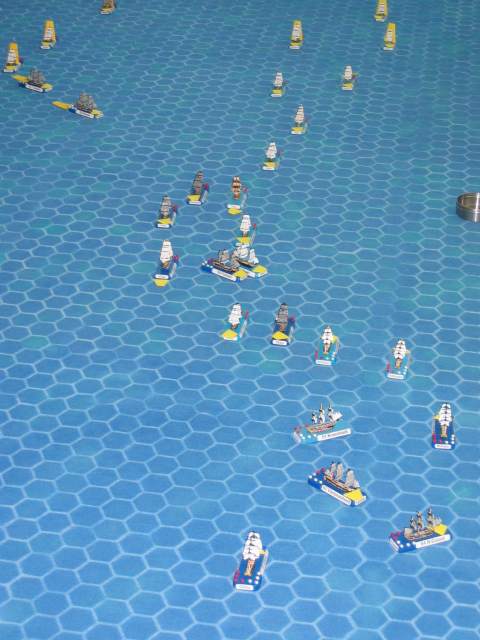
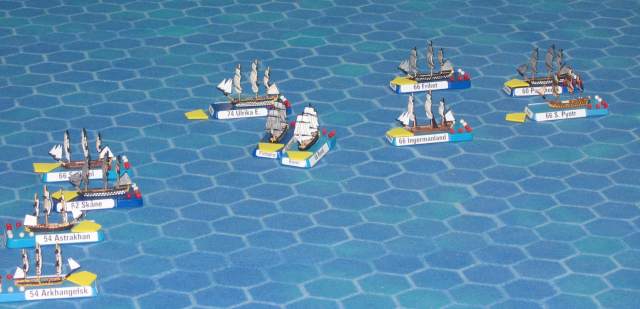
Worried that I would run into Revel this turn, I plotted 1. My worry was baseless, as Revel was smart enough to get the heck of out there -- which meant it was my turn for fire from Ulrika and a rake from Finland. Notwithstanding the beating that I took (two each of hull, sailors, and rigging), this was a fun turn for me as my rake on Frihet downed a rigging section and set her on fire. I realize that it's absurd to be proud of a lucky die roll, especially one made by the gamemaster and not me. But I was.
In other fun damage assessment, 60-gun Swedish Pommern was up against our 66-gun flagship Svyatoi Piotr, and lost a hull section this turn. Skåne lost a crew section and failed the resulting morale check to drop to E morale. It's always nice to have an enemy ship take the shooting penalty for a lower-than-D crew, and each morale drop is one step closer to striking....
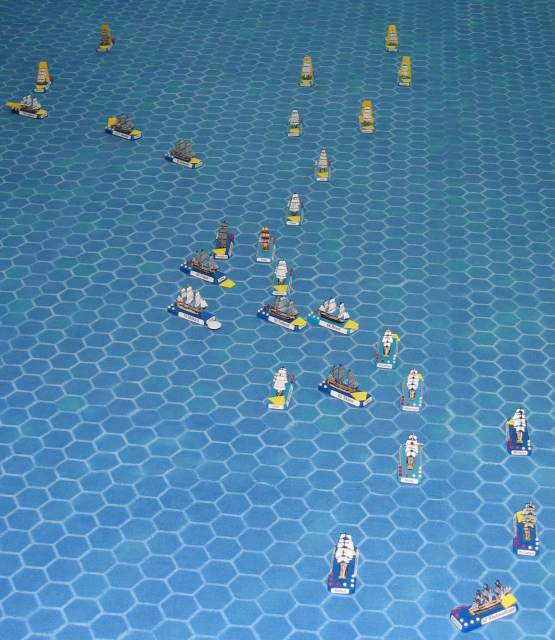
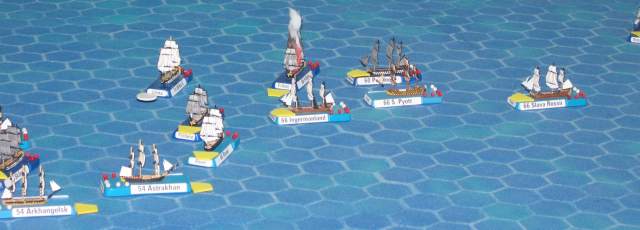
Wanting to avoid Frihet and hoping for a rake on Finland, I plotted 3. I got my rake, but Ulrika beat me to the last hex and so got a rake in turn against me. I ended up ramming Ulrika, and though there was no fouling nor grappling, I was at speed 0, and I never moved more than one hex per turn for the rest of the game.
In the center, you can see the cluster of ships forming. Things started to get hopelessly tangled. Skåne rammed Kronshtadt and fouled her, unfortunately leaving Skåne immobile while being bow raked. At least it wasn't in full-broadside position.
To the rear, note the Swedish Bremen about to cut off the Russian rear. Nice move, though Stockholm (in the upper left of the image) seems to be holding back.
Ingermanland took a bruising this turn, losing one rigging section and most of another, plus a hull section. The resulting morale check had me joining the "E"cho Morale Club, too.
As a small consolation, between Ingermanland and Revel we managed to knock off a rigging and two crew sections of Finland. Elsewhere, Skåne lost another hull section, and Kronshtadt lost a hull and a rigging section.
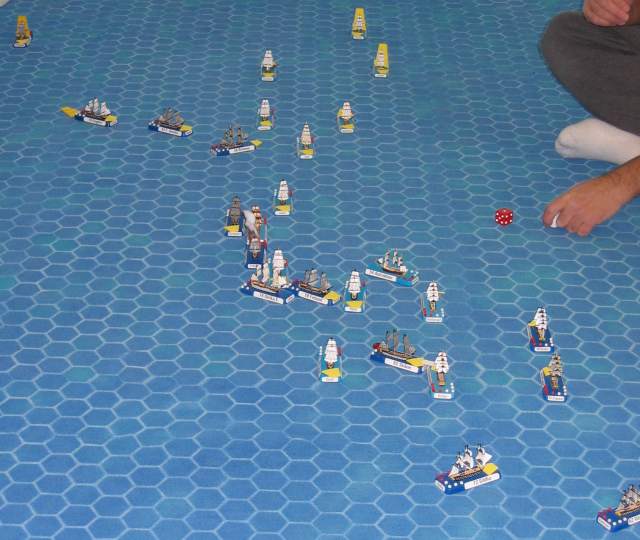
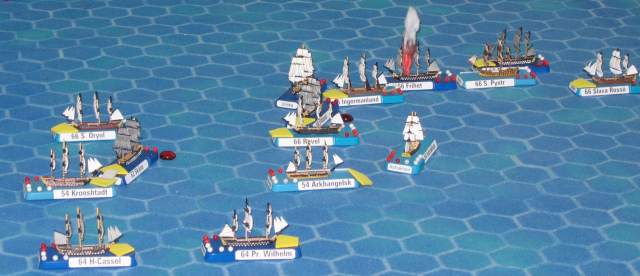
I tried to move P to avoid getting raked again, but Frihet came up and denied me the hex.
This was a good turn for the Russians. Revel set Finland on fire, and section losses caused morale checks that dropped Skåne and Finland to F morale and Pommern to E.
My fears of being literally between two fires ended as Frihet finally succeeded in putting her fire out. But that was little consolation compared to the beating that I took this turn. I lost a hull section, my second and most of my third rigging sections, and a lot of sailors.
(The white Othello markers are ships which might drift.)
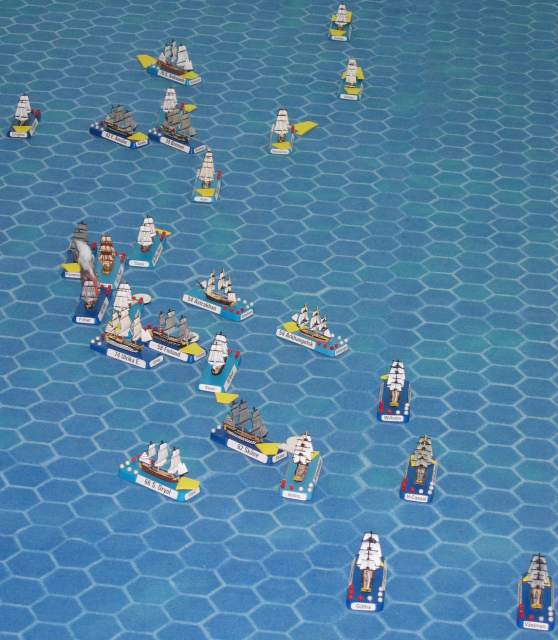
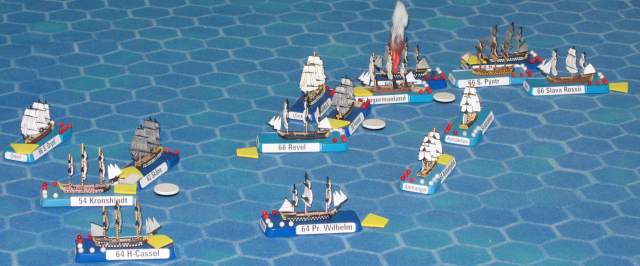
I didn't want to foul anyone, and I was happy raking Finland, so I just plotted 0 for this turn. I'm glad our flagship didn't try to move the extra hex.
Note again how the Swedes have twelve ships engaged compared to only eleven Russians. It's a small advantage, but possibly telling. See also how the situation continues to compact.
Gunnery honors went to the Swedes this turn, as though Skåne lost a rigging section (more or less immaterial since she was going nowhere anyway), while Revel lost a hull and rigging section, and failed the subsequent morale check to join Club Echo.
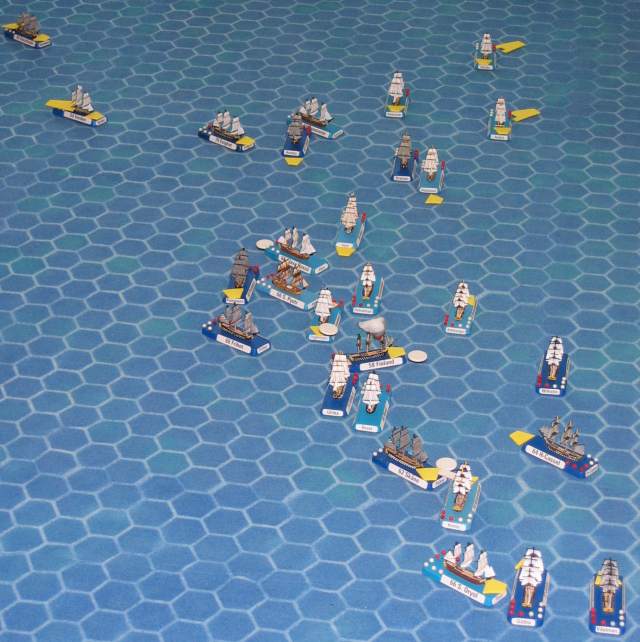
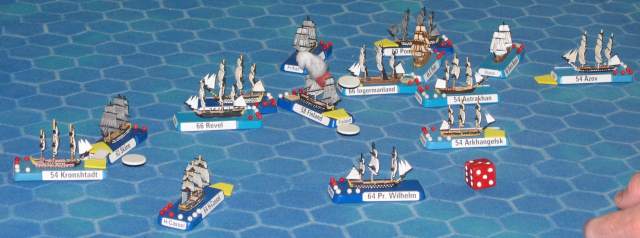
I see from my notes that I plotted 0 again, but that seems an odd move with Piotr just behind me. (Ingermanland has turned because of drift at the end of Turn 11). I'm not sure why I thought that was a safe plot -- was Piotr fouled or grappled? My memory fails me now.
I lost my third rigging this turn, leaving me practically immobile. Other Russian losses included Severnyi Oryol losing a hull and rigging section, Revel losing a crew section (a failing the morale check to drop to F morale). The Swedes saw Pommern and Bremen each lose a hull section, with one of them (my notes are unclear) falling to E morale. Stockholm fell to F morale, I'm not sure why.
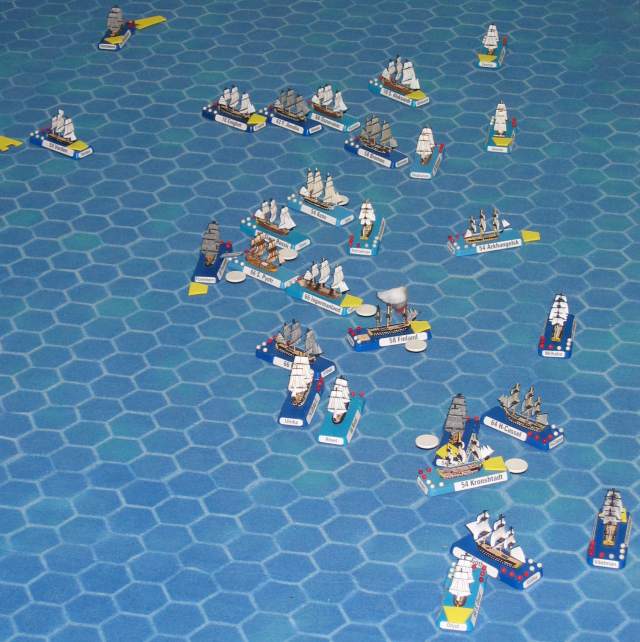
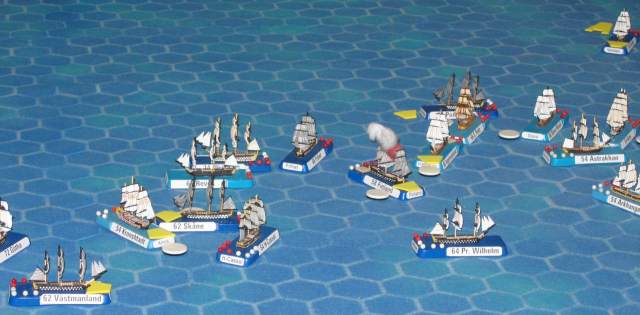
With so little rigging at this point I had few movement options. I plotted P this turn, hoping to get away from the still-burning Finland. My big fear was that either we would get fouled and I'd catch fire, too, or that Finland would explode and I'd be too close.
Looking back at the logs, my fear was somewhat misplaced as this was the last turn that I took any damage until near the end of the game.
The Swedes won the gun battle again this turn, with the Skåne's rudder getting destroyed and Frederica Amalia losing a rigging section, while the Russians saw Kronshtadt losing a crew and rigging section, and Osnovanie Blagopoluchiya (it just rolls off the tongue, doesn't it?) losing a hull section.
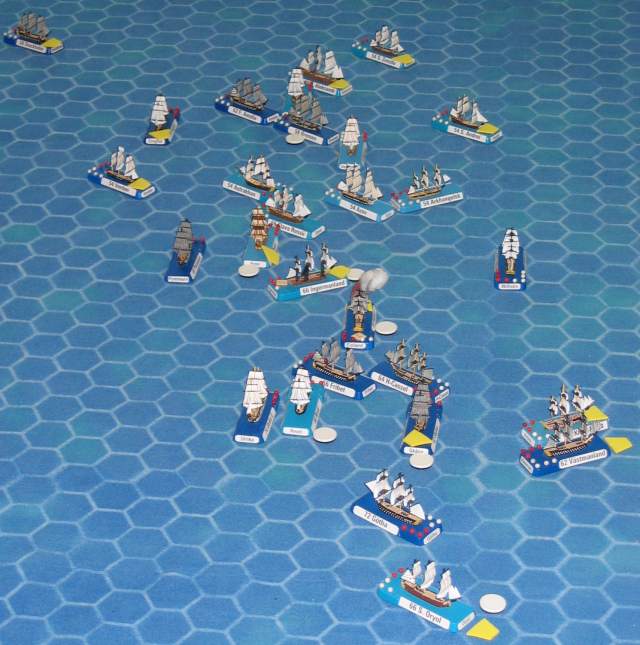
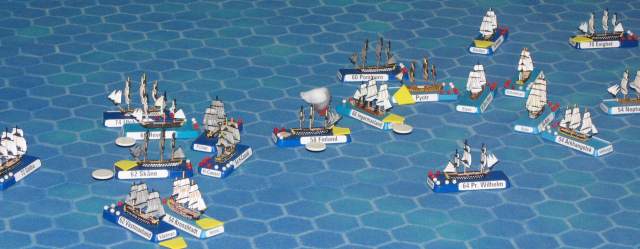
I moved one hex ahead to get the bow rake on Finland. Though my sails were shredded, I had most of my hull and guns and was hence still doing some respectable gunnery.
This was a bloody turn. On the Swedish side, Vastermanland and Prins Wilhelm lost hull sections, Finland lost a rigging section, and Bremen lost a crew section and dropped to E morale. For the Russians, Kronshtadt dropped to F morale, while poor Revel lost a crew, rigging, hull, and marine section.
At the end of the turn, Revel was forced to make five morale checks. Since she was at morale F, all it took was two failures to force her to strike. Beating the odds, she passed all five MCs, and continued to fight on.
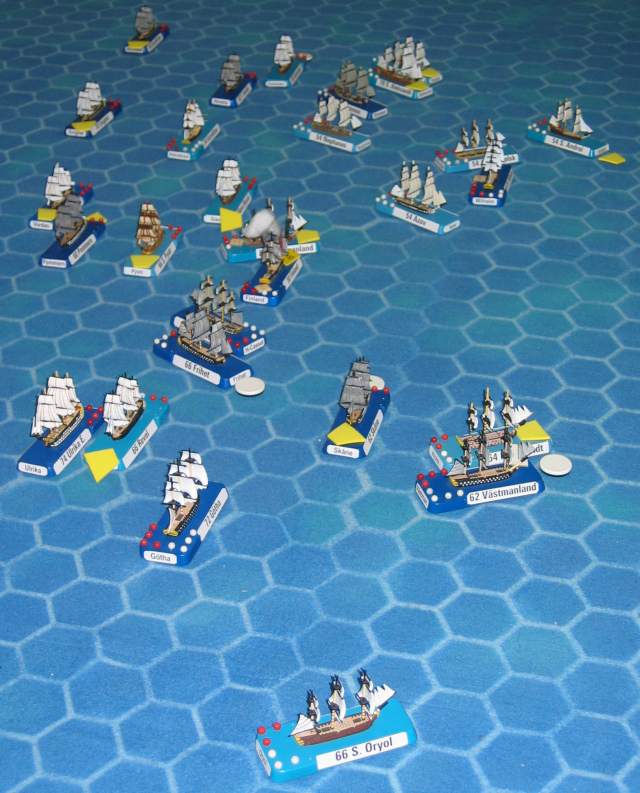
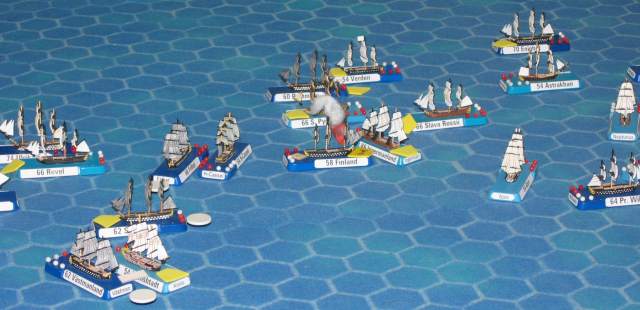
The general compacting of the battlefield continues.
In the gunnery phase, I notice that I took the half-broadside rake on adjacent Finland. In light of what was to come, I probably should've shot at approaching Enighet instead.
This turn the shot fell in favor of the Russians. At the cost of Astrakhan losing a hull section and dropping to E morale, we inflicting rigging and crew section losses on Vastermanland, rigging, hull, and crew section losses on Finland, a rigging section loss on Wilhelm, and hull and rigging section losses on Bremen with resulting drop to F morale.
This was Finland's fifth turn on fire. I think she had gone from wanting to put it out to wanting it to spread, in hopes of blowing up and taking a lot of Russians (including Ingermanland) with her. However, she put the fire out this turn. It didn't help her much, though, as the morale checks she had to take forced her to strike.
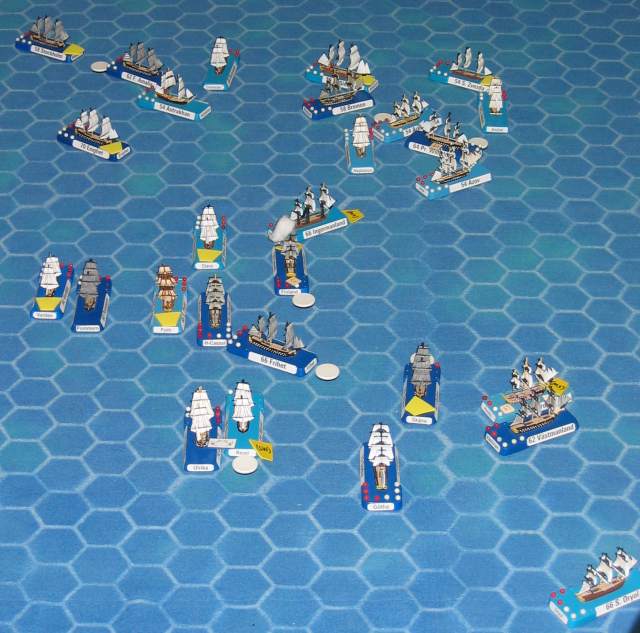
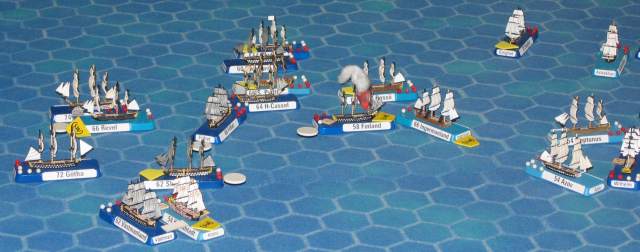
Happy to let Enighet come to me, and with no further fear of Finland, I plotted 0.
I personally had a huge morale boost from last turn, as I thought we had turned the battle around and my battered ship was still in play. But Revel's luck finally ran out and she struck. Other Russian losses were a hull section from Piotr and a rigging section from Astrakhan. In return we shot two hull sections and a crew section from Wilhelm; by the time the critical hits were resolved she was forced to take six morale checks, which Mark thought was a Close Action record. With a bit of bad luck on her part, she might have struck right then and there, but she failed only two and so dropped to F morale.
(Sorry, no overall image for this turn.)
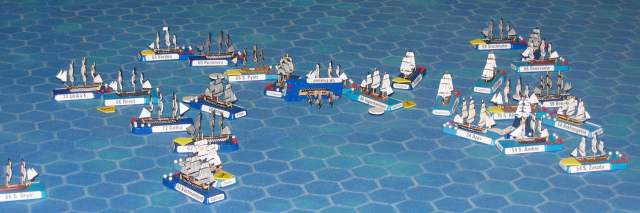
I again plotted zero, but Enighet manuevered smartly to avoid the rake.
Our playing area now had 28 ships (two of them struck) in a playing area of 19 x 15 hexes. At the beginning of the game, the equivalent area would have had 4 ships.
Gunnery favored the Swedes. Gotha lost a crew section due to a critical hit, but we lost crew sections from Piotr and Astrakhan, and rigging sections from Kronshtadt and Slava.
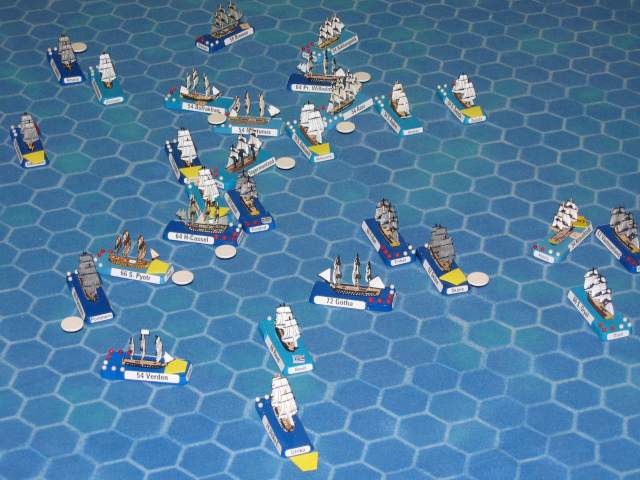
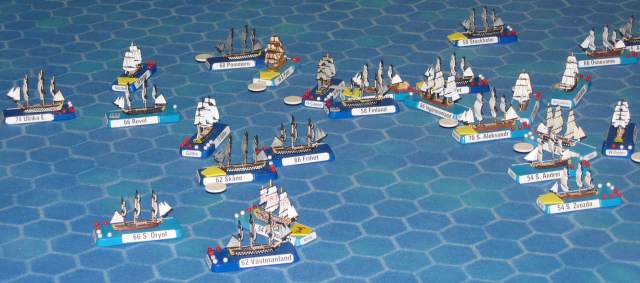
I remember a lot of discussion of past plots and possible speeds with neighboring ships, since there was a great possibility of a collision. In the end, I decided to plot 0 again. My gunnery duel with Enighet continued.
Gunnery was about even this turn. Kronshtadt and Slava lost hull sections, while Hessen-Cassel lost hull, rigging, and crew sections.
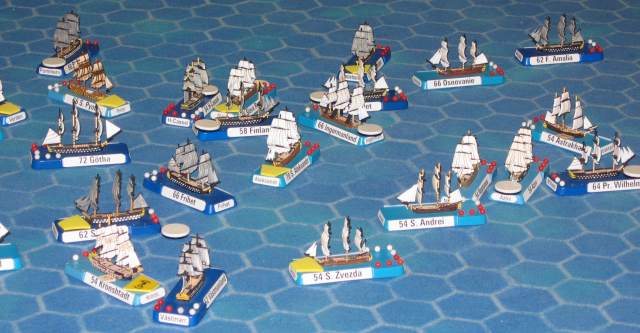
I plotted S for turn 19. I remember hearing some advice about not turning your stern to the enemy, but it seemed to me that I was possibly facing a stern rake if both Enighet and I stayed in place, but I was definitely facing a rake if I didn't maneuver. At any rate, Enighet obliged by moving away from my stern, and our gunnery duel continued.
I ended up losing my second hull section, and dropping to F morale. That would have been more demoralizing if I hadn't been happy to still be in the battle. Of more importance, battered Kronshtadt finally struck as result of five morale checks taken this turn.
Unfortunately, I neglected to take any pictures for turn 20. Gunnery again slightly favored the Swedes on that turn, as they lost two sections compared to three Russian sections, with our flagship Piotr falling to F morale.
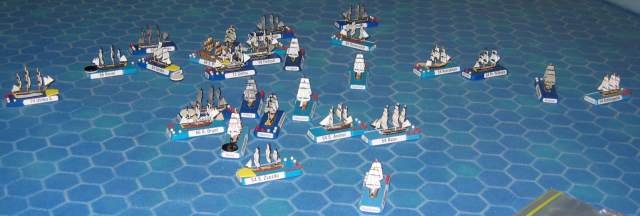
I think the finally consensus was that the Swedes won, though I'd be interested in seeing the final VP calculations to get a real sense of the magnitude of the victory.
All agreed that the scenario was very well balanced and made for a fun game.
Personally, I had a great time and look forward to playing again.